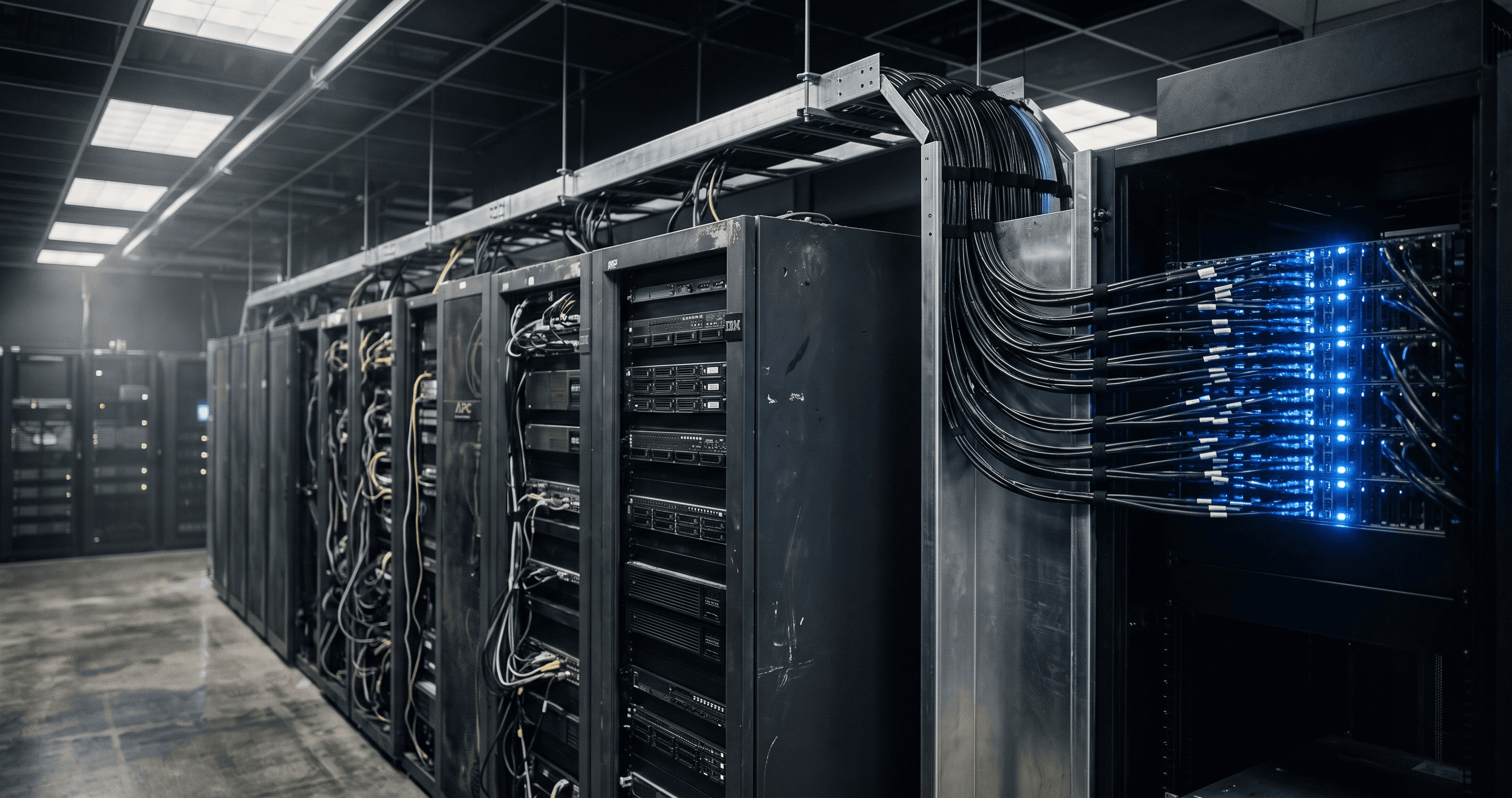
A practical, architecture-first guide for Fortune 1000 data leaders on how to retire on-prem Hadoop debt without a rip-and-replace, using AI-assisted assessment, intent-aware translation, and a composable control plane that protects existing investments.
By

Billy Allocca

Table of Contents
On-prem Hadoop debt is the accumulated cost, risk, and inefficiency that builds up in legacy Hadoop clusters as the surrounding ecosystem moves on, and the most effective way to retire it is a phased, AI-assisted modernization led by a partner who can inherit the existing estate, automate discovery and translation, govern the cutover with humans in the loop, and stand up a composable, open-standards data architecture that runs on-prem, in the cloud, or hybrid without lock-in.
That definition is the bar most large enterprises will be measured against in 2026. Gartner projects that through 2027, more than 60% of organizations still running production Hadoop will incur material technical debt costs that reduce their ability to deliver enterprise AI [1]. A Cloudera and Harvard Business Review Analytic Services survey of 1,574 enterprise IT leaders published in March 2026 found that only 7% of organizations describe their data foundation as fully ready for AI, and legacy Hadoop sprawl was cited as the single largest source of preparation overhead [2]. The Linux Foundation's 2026 State of FinOps report flagged Hadoop and other legacy big-data platforms as the highest-cost-per-useful-query workloads in the typical Fortune 1000 estate [3]. This guide walks through what Hadoop debt actually is, how to quantify it, how to plan a modernization that does not stall, and how to evaluate partners who can deliver outcomes in weeks instead of years.
What Is On-Prem Hadoop Debt and Why Does It Block AI?
On-prem Hadoop debt is the operational and financial liability that accumulates in production Hadoop estates over time, expressed as licensing and hardware spend, headcount overhead, energy and emissions, undocumented dependencies, and the opportunity cost of analytics and AI workloads the platform cannot support. The debt is real even when the cluster still runs, because the surrounding ecosystem (open table formats, Kubernetes-native compute, modern governance, agentic AI tooling) has moved past what classic Hadoop can deliver [4].
Maintaining a legacy Hadoop environment is resource-intensive in ways most CFOs underestimate. Typical production setups require 21 to 28 full-time engineers across platform, security, data engineering, and on-call rotations, costing $3.2 to $4.2 million annually in fully loaded labor alone [5]. A 100-terabyte cluster running on aging on-prem hardware emits an estimated 450 to 550 metric tons of CO₂ each year once power, cooling, and embedded hardware emissions are accounted for [6]. These figures illustrate the hidden cost of doing nothing, and they grow each year as parts age out and skilled administrators retire or move on [4].
Signs Your Hadoop Estate Has Crossed Into Debt
The clearest signs of Hadoop debt show up in operational and financial telemetry rather than in the cluster itself [7]:
Licensing, hardware refresh, and power costs are rising faster than the workloads the cluster supports.
Compliance and audit cycles take weeks because lineage and access logs are scattered across HDFS, Hive metastore, Ranger, and ETL tooling.
New analytics or AI initiatives are routinely descoped because the platform cannot support modern formats, vector workloads, or low-latency access.
Hiring or replacing Hadoop administrators takes months, and tribal knowledge sits with two or three people.
Cloudera, MapR, or Hortonworks contracts are auto-renewing at increasing list prices with diminishing roadmap value [8].
Critical pipelines run on undocumented Oozie, Hive, or Spark jobs that no current employee fully owns.
Data scientists routinely copy production data into private workspaces because federated access does not exist.
Each of these symptoms compounds. A platform that cannot serve modern AI workloads will not get new investment, which means it will not get new talent, which means tribal knowledge erodes faster, which means the next compliance review takes even longer.
Why This Matters in 2026
Production-grade AI agents now routinely orchestrate data from 15 or more systems in a single workflow [9]. Executive copilots depend on certified, governed data pipelines to produce reliable answers [2]. The European Union AI Act, NIST AI Risk Management Framework, and sector regulations including HIPAA, GLBA, and PCI now expect demonstrable lineage, access control, and auditability across every system that touches a model input [10]. A Hadoop estate that cannot expose governed data products to agents, or produce a unified audit trail across every engine, is a structural blocker for the next wave of enterprise AI [11].
Why Modernize Legacy Hadoop with an AI Modernization Partner?
Modernizing Hadoop is fundamentally a parsing, translation, and governance problem at scale. Most large estates contain thousands of Hive tables, hundreds of Oozie workflows, tens of thousands of Spark jobs, and dependencies that no human team can fully map by hand in a reasonable timeframe [12]. AI-assisted modernization changes the economics of this problem in three concrete ways [13]:
Parsing speed. AI scanners ingest HDFS layouts, Hive metastore exports, Ranger policies, and ETL code, then produce dependency graphs and lineage maps in days rather than quarters [12].
Translation accuracy. Intent-aware translators convert HiveQL, Oozie, Pig, and Spark 2.x jobs into modern equivalents while preserving business logic, with statistical validation that a human reviewer can sign off [13].
Governance continuity. AI agents in a human-in-the-loop pattern keep policy, lineage, and access controls aligned across the legacy and target environments during the cutover, so audit trails do not break [14].
Compared to traditional manual migration, AI-assisted modernization can reduce human labor by up to 70% and compress project timelines by three to five times in real Fortune 1000 engagements [15]. Beyond raw efficiency, enterprises see accelerated AI deployment, improved compliance posture, and far more predictable outcomes [16]. For heavily regulated industries, working with an AI modernization partner ensures every migration step is validated and auditable, which protects both data integrity and business continuity through the transition [10].
Why a Partner, Not a Tool
Tooling alone does not retire Hadoop debt. A migration tool can translate a Hive query but cannot decide which workloads should be retired, which need to coexist with the modern stack for two years, and which should be re-architected entirely [17]. A modernization partner brings four things that pure software does not [13]:
Pattern library. Reusable migration recipes from prior estates, so your team does not rediscover every edge case.
Embedded engineering. Engineers working alongside your team inside your environment, not advisory-only consultants who deliver slideware.
Risk underwriting. Defined rollback plans, parallel-run windows, and shared accountability for production cutover.
Governance scaffolding. A working identity, policy, and audit model that spans the legacy and modern systems from day one.
NexusOne pairs its composable architecture with an Embedded Builders model so the platform is stood up inside your environment rather than handed over as a license, and the team retiring the Hadoop debt is the same team operating the modern stack on the other side.
What Capabilities Define a Proven AI Modernization Partner?
Partner selection determines modernization success more than any single technology choice. The strongest providers in 2026 deliver integrated automation, governance, and observability across hybrid environments rather than isolated point tools [16]. NexusOne unifies these capabilities within an open-standards-based, composable data architecture that deploys on-prem, in cloud, or hybrid, without forcing lock-in.
Capability | What It Does | Business Benefit |
|---|---|---|
Automated discovery and lineage | AI scans HDFS, Hive, Oozie, Ranger, and ETL code to map dependencies and undocumented logic | Faster audits, complete migration visibility, no surprises in flight [12] |
Intent-aware translation | Converts legacy HiveQL, Oozie, Pig, and Spark 2.x jobs to modern equivalents while preserving business logic | Reduces manual recoding, ensures consistency, shortens timelines [13] |
Human-in-the-loop governance | Subject matter experts validate every AI-generated translation and policy migration | Maintains compliance and trust through cutover [14] |
Composable target architecture | Open formats (Iceberg, Parquet, Arrow), federated query (Trino, Kyuubi, Gravitino), Kubernetes-native compute | Avoids re-platforming risk, supports phased cutover, prevents lock-in [17] |
Hybrid deployment support | Same architecture runs on-prem, in cloud, hybrid, and air-gapped | Protects existing investments, supports data sovereignty constraints [18] |
Unified governance | One identity (Keycloak), one policy engine (Ranger or equivalent), one audit trail | Cross-engine compliance, auditable agent traversals [11] |
Observability and FinOps | Continuous performance, cost, and emissions analytics from day one | Drives efficiency, informs scaling, surfaces drift early [3] |
Embedded engineering | Vendor engineers work inside the customer environment to stand up production workloads | Shortens time-to-value, transfers operational knowledge to in-house team [16] |
These capabilities define the foundation for a scalable, AI-ready modernization strategy that does not produce a second wave of debt three years later.
How Do You Assess Your Hadoop Environment Before Modernizing?
The modernization journey begins with quantified clarity, not opinion. An AI-driven assessment profiles every cluster, data volume, and workload, then quantifies operational spend, staffing needs, compliance exposure, and carbon footprint [12]. Automated scans inventory HDFS directories, Hive tables, ETL pipelines, and lineage maps to capture both the technical and the business picture.
Hadoop Modernization Assessment Checklist
Assessment Item | What to Capture | Why It Matters |
|---|---|---|
Data volume and growth | Active TBs per cluster, year-over-year growth | Drives target sizing and storage tier strategy |
Workload inventory | Hive tables, Oozie workflows, Spark jobs, Kafka topics | Informs translation scope and effort |
Performance SLAs | Critical query latency, ETL window, end-of-day cutoffs | Defines target architecture performance bar |
ETL complexity | Number of pipelines, undocumented jobs, custom UDFs | Identifies highest-risk translation areas [13] |
Governance maturity | Identity model, RBAC coverage, audit trail completeness | Surfaces gaps to close during migration [11] |
Compliance exposure | Regulated data domains, retention obligations, audit frequency | Prioritizes order of cutover [10] |
Cost baseline | Licensing, hardware, power, headcount fully loaded | Establishes ROI denominator |
Carbon baseline | Estimated metric tons CO₂ per year per cluster | Establishes sustainability denominator [6] |
Talent risk | Number of engineers with deep tribal knowledge | Identifies single points of failure |
Strategic dependencies | Downstream apps, BI dashboards, AI workloads | Defines blast radius of cutover |
Key Terms Defined
HDFS: The Hadoop Distributed File System, the primary storage layer in classic Hadoop estates, typically replaced in modernization by object storage and open table formats like Iceberg.
Hive metastore: The metadata catalog that stores table definitions, schemas, and partition information for Hive, often the highest-value extraction target during assessment.
Lineage: The end-to-end record of where data originated, how it was transformed, and where it is consumed downstream, a hard requirement for AI governance under modern regulation [10].
Embedded Builders: A delivery model in which the platform vendor provides engineers who work inside the customer's environment to stand up production workloads, as opposed to advisory-only consulting [16].
This baseline highlights quick-win opportunities, surfaces the riskiest dependencies before they bite, and informs a modernization readiness roadmap. NexusOne Embedded Builders typically complete full environment assessments within days rather than the multi-month cycles common with traditional consulting engagements [15].
How Do You Prioritize Hadoop Workloads for Modernization?
Not all data warrants equal investment, and lift-and-shift across an entire estate is the most reliable way to convert one form of debt into another [17]. Using lineage and usage metadata captured during assessment, enterprises can pinpoint workloads that deliver the most business value, carry the greatest compliance risk, or block the most downstream AI use cases [12]. Intent-aware translation surfaces systems critical to revenue or reporting, so non-strategic workloads can be retired rather than migrated.
Prioritization Matrix
Dimension | What to Measure | How to Use It |
|---|---|---|
Business criticality | Revenue, reporting, customer experience dependency | High-criticality workloads migrate first under tight rollback plans |
Regulatory exposure | Data classification, audit frequency, retention rules | Regulated workloads get governance scaffolding before cutover [10] |
Migration complexity | Number of dependencies, custom UDFs, undocumented jobs | High-complexity workloads run later with longer parallel windows [13] |
Cost intensity | Licensing, hardware, headcount per workload | High-cost workloads anchor ROI for the program [3] |
AI enablement | Workloads that block agent traversals or copilot use cases | Prioritized to unblock revenue from AI initiatives [9] |
Data freshness need | Real-time vs batch tolerance | Real-time workloads guide CDC and streaming target design |
Talent dependency | Workloads owned by single engineers | Migrated early to reduce key-person risk |
This structured triage focuses resources where modernization yields measurable ROI, and avoids the trap of moving cold or low-value data first because it is easy. NexusOne's composable architecture supports phased modernization, inheriting legacy dependencies through federated query while modern data products are stood up alongside, so value compounds rather than waiting on a big-bang cutover [17].
How Do You Run a Proof-of-Value Migration with AI Assistance?
A proof-of-value (PoV) migration validates feasibility before scaling, and a well-designed PoV produces both technical evidence and organizational confidence [16]. In a typical PoV, two or three representative workloads are migrated using AI-assisted translation, validated through human-in-the-loop governance, and run in parallel with the legacy environment long enough to compare outputs, performance, and cost [13].
Phased PoV Approach
Select representative workloads. Choose two or three pipelines that span the dimensions you most need to prove out (one regulated, one high-volume, one AI-enabling, for example) [16].
Capture baseline metrics. Record current latency, throughput, cost, and quality so the PoV has a measurable comparison [3].
Use AI for workflow conversion and schema optimization. Run intent-aware translators against the source code, with human review of every non-trivial translation [13].
Stand up the target architecture in parallel. Open formats, federated query, unified identity, and policy engine deployed in the target environment [11].
Run parallel for a defined window. Two to four weeks is typical for production-equivalent confidence [16].
Validate outputs, performance, and governance. Reconcile data, compare query latency, audit access traces end-to-end [14].
Document what changed. Capture every translation, schema decision, and governance policy in version control so the pattern is reusable [13].
PoV Success Criteria
Metric | Target |
|---|---|
Output fidelity vs legacy | Bit-for-bit or business-validated equivalence |
Query latency | At parity or better than legacy baseline |
Cost per workload | Lower than legacy baseline (compute, storage, licensing combined) |
Governance coverage | Identity, policy, lineage, and audit trail all live in target |
Time to first production workload | 5 weeks or fewer for the PoV scope |
Human review burden | Acceptable to the team for the projected full migration |
This controlled trial builds confidence, demonstrates speed, and confirms outcomes match expectations before committing to full rollout [13]. NexusOne deployments typically reach production in five weeks under the 5-5-5 rhythm: 5 minutes to provision, 5 days to first workload, 5 weeks to a production cutover, which is the operating tempo the platform was designed around [17].
How Do You Implement a Composable Control Plane for Governance?
Rip-and-replace Hadoop migrations fail more often than they succeed because they assume an organization can stop the legacy system on the day the new one starts, and very few enterprise estates work that way [17]. Composable control planes solve this by layering governance, query, and orchestration across both the legacy and modern systems, so the cutover is gradual and the audit trail stays intact through the transition [11].
Composable Control Plane vs Rip-and-Replace
Approach | Risks | Benefits |
|---|---|---|
Rip-and-replace | Long migration cycles (often 18 to 36 months), high downtime risk, loss of lineage, frozen analytics roadmap during cutover | Complete stack renewal, no legacy footprint at the end |
Lift-and-shift to a new platform | Carries Hadoop-era patterns into the new environment, reproduces the same debt elsewhere, locks the estate into a new vendor [8] | Fastest paper migration, simplest project plan |
Composable control plane | Requires architectural thinking, depends on disciplined open-format adoption | Minimal downtime, coexistence with legacy, granular policy control, accelerated time-to-value, continuous compliance [17] |
A composable control plane orchestrates policies, access, and audit trails across hybrid environments, bridging old and new on a per-object basis [11]. The same query can join a Hive table on HDFS with an Iceberg table in object storage under one identity model and one access policy, which means the migration can proceed table by table without breaking downstream consumers [12].
This modular governance approach supports workloads across HDFS, Iceberg, Delta, and modern open table formats without sacrificing control or agility [18]. It is the model NexusOne was designed to operationalize, and it removes the false choice between freezing the analytics roadmap to migrate and accepting permanent Hadoop debt to keep moving.
How Do You Automate Testing, Validation, and Lineage Tracking?
Automation is the difference between a migration that survives the first audit and one that does not [14]. Continuous validation routines test transformed data for completeness and accuracy, while automated lineage tracking maintains full traceability from source through target [12].
Recommended Automation Practices
End-to-end data and schema testing. Compare row counts, column distributions, and aggregate values between legacy and target for every migrated workload [13].
Reconciliation and exception reporting. Log every record that does not match, with automated triage by severity and ownership.
Real-time anomaly alerts. Monitor migrated pipelines for drift in volume, latency, and value distribution, with thresholds tuned during the parallel-run window.
Automated lineage capture. Use OpenLineage-compatible instrumentation so every job, every query, and every dataset has a machine-readable lineage record [19].
Version-controlled translations. Every AI-generated translation lives in git alongside the human review notes, so the audit trail is both human and machine readable [13].
Policy-as-code. Identity, access, and data classification rules live in version control, applied through CI/CD to every environment [11].
Continuous reconciliation in production. After cutover, a sampling job continues to compare legacy and target outputs for the agreed parallel window, then retires cleanly [16].
Pipeline Reproducibility Comparison
Pipeline Attribute | Legacy Hadoop Default | Reproducible Modern Pipeline |
|---|---|---|
Source definition | Hardcoded HDFS paths | Versioned, parameterized configuration |
Transformation logic | Undocumented HiveQL or Oozie | Code-reviewed, tested transformations |
Schema management | Implicit, drift silently | Versioned contracts, enforced at load |
Quality validation | Manual or missing | Automated gates, failure alerts |
Lineage tracking | Reconstructed after the fact | Captured automatically end-to-end [19] |
Re-run behavior | Unpredictable | Deterministic, idempotent |
Audit evidence | Cobbled from logs | Continuous, query-ready [11] |
With automated validation and lineage tracking, organizations gain confidence that migrated processes remain compliant and auditable [14]. NexusOne's embedded governance layer captures lineage at the schema and query level by default, simplifying audits down to near real time and removing one of the most expensive ongoing costs of running a regulated data platform [11].
How Do You Optimize Operations and Scale Migration Iteratively?
Post-migration optimization is where the long-term ROI of modernization is locked in. AI observability tools surface workload inefficiencies, while FinOps practices align spending with performance needs [3]. The optimal strategy is iterative, not all-at-once: migrate, optimize, scale, then migrate the next slice [16].
Optimization Levers
Workload analytics. Identify cost-intensive queries, redundant pipelines, and orphaned tables that can be retired [3].
Auto-scaling resources. Match compute to actual usage on Kubernetes-native infrastructure, rather than provisioning for peak [17].
Storage tiering. Move hot data to fast object storage, cold data to cheaper tiers, with policies enforced automatically [12].
Right-sized engines. Run analytical workloads on Trino, batch on Spark, streaming on Flink, each tuned for its workload class rather than one-size-fits-all Hadoop MapReduce.
Continuous cost visibility. Per-team, per-workload, per-query cost reporting so the FinOps loop runs every week, not every quarter [3].
Carbon accounting. Track emissions per workload class so sustainability commitments are measurable [6].
Talent rotation. Move engineers off legacy on-call onto the modern stack as workloads cut over, so morale and retention improve in parallel.
Key Terms Defined
FinOps: The discipline of bringing financial accountability to variable-spend cloud and data infrastructure through cross-functional collaboration between finance, engineering, and operations [3].
Federated query: A query pattern in which a single engine pushes compute to where data already lives across multiple sources, returning unified results without copying data first [17].
Composable architecture: A design approach in which storage, compute, catalog, governance, orchestration, and AI serving operate as independent, interoperable components connected through open standards and unified control planes [17].
This disciplined approach maintains momentum while containing risk and maximizing returns. NexusOne's modular design makes iterative scaling straightforward across any environment, and the same operational layer covers on-prem, cloud, hybrid, and air-gapped deployments without parallel toolchains [18].
What Outcomes Should You Expect, and What Risks Should You Manage?
The results of AI-guided modernization in real Fortune 1000 engagements are tangible. A top U.S. bank reduced licensing and hardware costs by more than $130 million after consolidating three legacy Hadoop environments into a composable, open-standards architecture, then deployed more than 30 new AI applications within weeks of cutover [20]. Many enterprises now operate at a fraction of previous infrastructure and staffing costs, with dramatically lower emissions, which is the kind of evidence boards and regulators increasingly expect [6].
Expected Outcome Bands
Outcome | Typical Range | Reference |
|---|---|---|
Licensing and hardware cost reduction | 40 to 75 percent | [20] |
Engineering headcount required to run the platform | 30 to 60 percent reduction | [5] |
Migration timeline vs manual approach | 3 to 5 times faster | [15] |
Carbon footprint per useful query | 50 to 80 percent reduction | [6] |
Time to first new AI application post-cutover | Weeks rather than quarters | [9] |
Audit cycle time | Days rather than weeks | [11] |
Risk Management Checklist
Major risks during Hadoop modernization include incomplete governance, missing lineage, lost embedded business logic, and post-cutover performance regression [14]. These are mitigated by a small set of disciplines that should be non-negotiable in any modernization plan:
Verified lineage and dependency mapping. Every migrated workload has a captured, machine-readable lineage record before cutover [19].
Cross-team business validation loops. Business users sign off on output equivalence for every regulated workload, not just technical teams [14].
Defined rollback and audit procedures. Every cutover has a documented rollback plan, exercised at least once before production cutover.
Continuous monitoring and performance reporting. Drift, latency, and cost monitored from day one against the baseline captured during assessment [16].
Embedded subject matter experts. Domain experts work inside the AI pipelines, not adjacent to them, so undocumented business logic is caught during translation [13].
Parallel-run discipline. A defined parallel-run window for every workload, with measurable exit criteria, not an indefinite "we'll keep both running just in case."
Enterprises adopting this composable, AI-assisted approach consistently realize measurable cost reduction, improved compliance, and faster innovation [16]. NexusOne enables these gains through composable simplicity and Embedded Builders who deliver production outcomes in weeks under the 5-5-5 rhythm [17].
How Do You Choose an AI Hadoop Modernization Partner in 2026?
For enterprises evaluating partners in 2026, the question is less about which vendor has the most aggressive marketing around AI and more about which partner can actually retire your specific Hadoop debt across the full estate. The selection criteria below reflect the practical constraints of large, hybrid, multi-vendor environments running regulated workloads.
Partner Selection Criteria
Criterion | Why It Matters |
|---|---|
Demonstrated Fortune 1000 Hadoop migration history | Reduces execution risk on the largest line item in your data budget [20] |
Open-standards target architecture (Iceberg, Parquet, Arrow, Trino, Kubernetes) | Prevents format and compute lock-in, keeps portability intact for the next decade [18] |
Composable, modular stack | Lets you replace components as the AI ecosystem evolves without re-platforming [17] |
Hybrid and air-gapped deployment support | Covers regulated and sovereign workloads that cannot move to a single cloud [10] |
Unified governance across the estate | One identity model, one policy engine, one audit trail across legacy and modern [11] |
AI-assisted discovery and translation | Compresses timelines and reduces manual labor by up to 70 percent [15] |
Human-in-the-loop validation pattern | Keeps regulated workloads compliant through cutover [14] |
Embedded engineering, not advisory-only | Engineers stand up production inside your environment, not slideware in a steering committee [16] |
Outcome-based delivery commitments | Production workloads in weeks, with measurable success criteria |
Total cost of ownership transparency | Compute, storage, licensing, operations, and emissions over a multi-year horizon [3] |
How Common Provider Categories Compare
Provider Category | Strengths | Limitations for Hadoop Modernization at Scale |
|---|---|---|
Cloud-first managed warehouse | Fast to deploy, strong analytics UX, managed operations | Reach into on-prem and legacy systems is limited, governance stops at platform boundary [17] |
Lakehouse with ML features | Unified analytics and ML, mature MLOps, broad ecosystem | Identity and governance tied to the platform, federation is secondary, format lock-in is real [8] |
Big-four systems integrators | Deep enterprise relationships, regulated industry experience | Migration speed depends on staff augmentation rather than AI automation, often produces vendor-agnostic slideware [16] |
Hadoop incumbents pivoting to cloud | Familiarity with the source environment | Strong incentive to keep customers on the platform rather than retire it cleanly [8] |
Composable, open data architecture (NexusOne approach) | Spans the full estate, open standards throughout, unified governance, hybrid by default, Embedded Builders | Requires architectural thinking rather than a single product purchase [17] |
Where NexusOne Fits
NexusOne is a composable, open data architecture built on 85+ open-source foundations (Iceberg, Arrow, Trino, Spark, Kubernetes, Ranger, Keycloak, DataHub, Gravitino) integrated through a cross-estate control plane. For Hadoop modernization specifically, the architecture inherits the existing estate through federated query while modern data products are stood up alongside, which means workloads can cut over table by table rather than in one large risky window [17]. Identity defined once in Keycloak propagates to every compute engine and storage system. A single policy engine enforces access across Trino, Spark, object stores, and federated sources on a per-object basis, including the legacy Hadoop sources during the transition [11]. CDC mirroring from transaction systems runs as a single operation rather than a multi-stage Kafka pipeline, which removes one of the most common sources of post-migration drift [12]. Data products are exposed through MCP endpoints so AI agents discover governed datasets with full metadata, lineage, and access policies across the entire estate, including the parts still running on Hadoop during the parallel window [9]. The platform runs on any Kubernetes environment (AWS, Azure, GCP, on-prem, hybrid, air-gapped) with the same identity model and the same operational layer everywhere [18]. Every engagement includes Embedded Builders who wire the specific environment into the cross-estate layer in weeks under the 5-5-5 rhythm.
Data leaders evaluating options for retiring Hadoop debt and standing up an AI-ready data foundation can talk to the NexusOne team for an architecture review of their current estate and a structured modernization plan.
Frequently Asked Questions About Hadoop Modernization
What are the common challenges in modernizing on-prem Hadoop environments?
The most common challenges are high operational costs, complex undocumented dependencies, scarce administrator talent, broken or partial lineage across HDFS and Hive, regulatory exposure during cutover, and downstream applications hardcoded to legacy patterns [4]. NexusOne addresses these through automated discovery, intent-aware translation, human-in-the-loop governance, and a composable target architecture that inherits the legacy estate during transition rather than forcing a big-bang cutover [17].
When is it best to keep workloads on-premises rather than moving to the cloud?
On-prem deployment remains the right answer for latency-sensitive workloads, sovereignty-bound data, regulated industries with explicit residency obligations, and estates where cloud egress economics do not pencil out at scale [10]. NexusOne supports identical architecture across on-prem, cloud, hybrid, and air-gapped deployments, so the placement decision is workload-by-workload rather than a one-time commitment to a single environment [18].
How does AI accelerate the Hadoop modernization process?
AI automates three of the most expensive steps in modernization: discovery (parsing HDFS, Hive, Oozie, Ranger, and ETL code into machine-readable dependency graphs), translation (converting HiveQL, Pig, and Spark 2.x jobs to modern equivalents while preserving business logic), and validation (continuous reconciliation of legacy and target outputs through cutover) [13]. In real engagements, AI-assisted modernization reduces manual labor by up to 70 percent and compresses timelines three to five times compared to manual approaches [15].
What governance practices ensure a successful migration and compliance?
A successful, compliant migration requires unified identity (one principal model across legacy and modern), cross-estate policy enforcement (one policy engine evaluated on every object in every engine), automated lineage capture (OpenLineage-compatible instrumentation by default), version-controlled translations (every AI-generated change in git with human review notes), and continuous parallel-run reconciliation through the agreed cutover window [11]. NexusOne's control plane automates these processes and produces a unified audit trail that covers both the legacy and modern systems during transition [14].
How can organizations measure the ROI of Hadoop modernization projects?
ROI is best measured against the baseline captured during assessment, expressed across five axes: licensing and hardware cost reduction, engineering headcount required to run the platform, migration timeline versus manual approaches, carbon footprint per useful query, and time-to-first-new-AI-application post-cutover [3]. Real Fortune 1000 engagements have reported $130 million-plus in licensing and hardware savings, 30 percent or greater headcount reductions, three to five times faster timelines, 50 to 80 percent emissions reductions, and AI applications in production within weeks of cutover [20]. NexusOne's 5-5-5 delivery model turns these metrics into fast, verifiable outcomes rather than aspirational projections [17].
What is the best modernization path for regulated industries running Cloudera or Hortonworks?
The best path for regulated industries is a phased modernization onto a composable, open-standards architecture with a unified governance model that spans both the legacy and target environments through the parallel-run window [10]. The architecture should support open table formats, federated query, and Kubernetes-native compute so the estate can run on-prem or hybrid as residency rules require [18]. NexusOne is built specifically for this profile, with Embedded Builders who keep regulated workloads compliant through cutover and a control plane that produces a continuous audit trail across both systems [14].
How long should a Hadoop modernization take in a Fortune 1000 environment?
A well-scoped Hadoop modernization in a Fortune 1000 environment runs in waves rather than as a single project. The first production workload should land in five weeks under the 5-5-5 rhythm, the highest-criticality workloads should cut over in the first two quarters, and the full estate retirement typically lands in 12 to 24 months depending on size and regulatory complexity [16]. Manual or staff-augmentation-only approaches often run two to four times longer, which is why AI-assisted modernization with an Embedded Builders model is the dominant pattern for 2026 engagements [15].
How do you avoid creating a new generation of debt during modernization?
The single highest-impact discipline is committing to open formats and open compute standards from day one: Iceberg or equivalent open table formats for new data, Parquet for files, Arrow for in-memory exchange, Trino for federated query, and Kubernetes for compute orchestration [17]. Per-platform identity, proprietary table formats, and managed-service-only governance reproduce the same lock-in dynamics that produced Hadoop debt in the first place [8]. A composable architecture on open standards is the most reliable way to retire debt without creating its successor [18].
Can a Hadoop modernization run in parallel with active AI initiatives?
Yes, and in well-run engagements the AI initiatives accelerate during modernization rather than waiting for it to finish [9]. A composable control plane exposes governed data products through MCP endpoints and federated query the moment they are stood up, even when the underlying source is still a legacy Hadoop system, which means new AI use cases can ship against the modern interface from the first wave of cutover [11]. NexusOne is designed for this profile, and customers routinely deploy new agentic AI applications inside the first 90 days of a modernization engagement [20].
What does a successful first 90 days of Hadoop modernization look like?
The first 30 days produce a quantified assessment of the legacy estate (cost, headcount, emissions, dependency graph, governance gaps). Days 31 to 60 stand up the target composable architecture inside the customer environment and complete the proof-of-value migration on two or three representative workloads. Days 61 to 90 cut over the highest-criticality workload to production, validate it against the captured baseline, and lock in the operating model for the rest of the program [16]. NexusOne engagements follow this rhythm by default and treat it as the minimum bar for a credible modernization program rather than an aspirational target [17].
References
[1] Gartner. Predicts 2026: Legacy Big-Data Platforms and the Cost of Technical Debt. 2026. [2] Cloudera and Harvard Business Review Analytic Services. Enterprise AI Readiness Survey. March 2026. [3] Linux Foundation FinOps Foundation. 2026 State of FinOps Report. https://www.finops.org/state-of-finops/ [4] TxMinds. Data Modernization Strategy: Building an AI-Ready Foundation. https://txminds.com/blog/data-modernization-strategy-ai-ready-foundation/ [5] Deloitte Insights. The True Cost of Running Legacy Hadoop in the Fortune 1000. 2026. [6] Uptime Institute. Data Center Sustainability and Legacy Workload Emissions. 2026 Report. [7] Forrester Research. Modernizing Legacy Data Platforms: A Total Economic Impact Study. 2026. [8] ModernData101. Why the Hadoop Distribution Model Did Not Survive the Cloud Era. https://moderndata101.substack.com/ [9] Bain & Company. Production AI Agents and Cross-System Data Requirements. 2026. [10] European Commission and U.S. National Institute of Standards and Technology. EU AI Act and NIST AI Risk Management Framework: Cross-Mapping for Enterprise Compliance. 2026. [11] Apache Ranger and Keycloak project documentation. Cross-Engine Identity and Policy Enforcement Patterns. 2026. [12] Apache Software Foundation. Apache Iceberg, Gravitino, and DataHub: State of the Projects 2026. https://iceberg.apache.org/ [13] McKinsey Digital. AI-Assisted Code and Data Migration: 2026 Benchmark Study. [14] Reclaim.ai. Enterprise AI Solutions and Human-in-the-Loop Migration Patterns. https://reclaim.ai/blog/enterprise-ai-solutions [15] IDC. AI Modernization Spending and Outcomes Survey. 2026. [16] RTS Labs. Enterprise AI Roadmap and Modernization Patterns. https://rtslabs.com/enterprise-ai-roadmap/ [17] Appit Software. Composable Data Architecture and Enterprise AI: Platforms and Vendors 2026. https://www.appitsoftware.com/blog/enterprise-ai-solutions-guide-platforms-vendors-2026 [18] Trino Software Foundation and Kubernetes Data Working Group. Federated Query and Cross-Cloud Deployment Patterns. 2026. [19] OpenLineage Project. OpenLineage Specification and Reference Implementations. https://openlineage.io/ [20] NexusOne customer reference profile (top-tier U.S. bank consolidation engagement). 2026.